
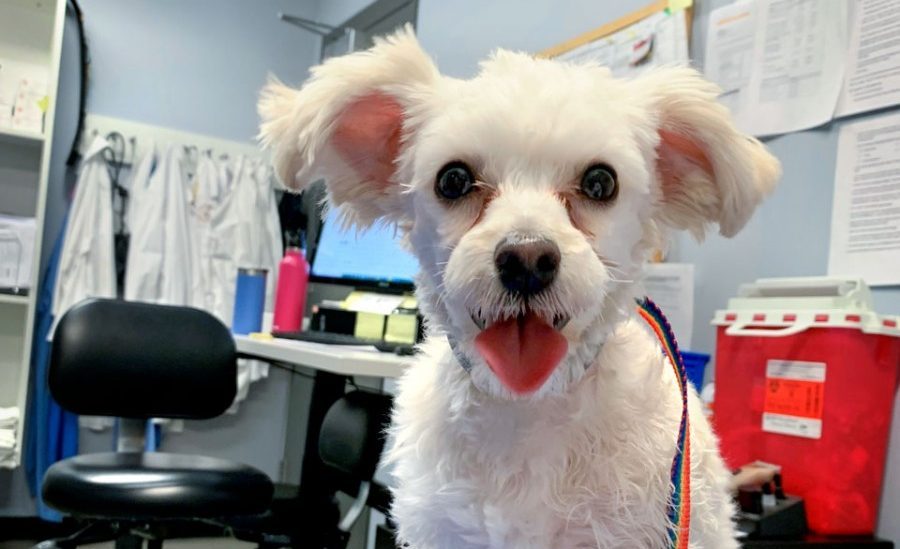
The first of its kind heart procedure at Cornell Veterinary Animal Hospital has proved successful for a little dog named Buttercup. At 11 months old the Maltese-Yorkie (Morkie) had heart surgery at Cornell University Hospital for Animals. She suffered from a deadly congenital cardiac defect. She had a heart murmur since she was born. While she had good energy at home, she would begin coughing if she got excited or exercised. Buttercup came to Cornell, where the cardiology team diagnosed her with patent ductus arteriosus (PDA), the most common congenital cardiac defect in dogs.
At most hospitals, Buttercup would have had to go through more invasive and painful surgery to fix her condition. But Cornell had a better solution. “All dogs have a ‘ductus arteriosus’ (DA) in utero,” says cardiology resident Dr. Christophe Bourguignon. “It is a vessel allowing normal blood oxygenation inside their mom, as they do not have functional lungs to breathe and use the placenta to do so. A few minutes or hours after birth, this vessel closes, allowing the lungs to take over completely. Occasionally, some dogs’ DA does not close and stay ‘patent,’ hence the term PDA.”
While the DA is open, this vessel allows a massive amount of blood to overflow the lungs and the heart. “Most dogs will eventually go into congestive heart failure and die,” Dr. Bourguignon says. “Drugs do not work well, if at all.”
“The vessel needs to be closed as soon as possible to prevent the complication of heart failure,” said Dr. Romain Pariaut, associate professor and section chief of cardiology. “This condition causes a very characteristic heart murmur that any veterinarian should be able to recognize with a stethoscope at the time of a puppy’s visit.”
“The nice and unusual thing with Buttercup is that we offered to modify the catheter-based occlusion technique in order to access the PDA without having to open her chest,” Dr. Bourguignon said.
This technique is much trickier – the catheter must be guided inside and through the heart’s chambers before it can reach the pulmonary artery, and cardiologists must use a small flexible wire to probe the wall of the artery until they find the opening of the PDA. In just under two hours, Pariaut and Bourguignon successfully closed the PDA in Buttercup. “We were able to show that we can do this other, more complicated technique to fix PDAs in smaller patients,” Pariaut said.
Buttercup recovered well from the surgery and today she is doing well.
For more information visit Cornell College of Veterinary Medicine https://www.vet.cornell.edu/hospitals
That is such a cute story